Remodel vs Move in Bellaire: What Makes Sense?
July 23, 2026
July 23, 2026
If you love Bellaire but your house no longer fits your life, you are not alone. Many homeowners reach a point where they have to choose between investing in the home they have or buying one that works better from day one. The good news is that Bellaire gives you clear signals about when each path makes sense, and understanding those signals can save you time, money, and stress. Let’s dive in.
Bellaire is a city where redevelopment plays a big role because it is already nearly built out. According to the city’s planning documents, future change is largely expected to come from redevelopment of existing structures and property improvements rather than large areas of new development.
That matters because many homeowners are trying to solve the same problem at once. You may want more space, a better layout, a home office, a larger garage, or room for an accessory structure. In Bellaire, those goals often run into lot limits, setbacks, floodplain rules, and the reality that land value is a major part of the equation.
The market backdrop also raises the stakes. HAR reported a June 2026 average Bellaire sale price of $1.374 million and a median sale price of $1.305 million. Zillow showed a June 30, 2026 median list price of $1.183 million with 58 homes for sale, which gives you a sense of the price level you are comparing against.
In Bellaire, the same remodel idea can be realistic on one lot and impossible on another. The city’s rules vary by zoning district, so the legal building envelope on your property should shape your decision before you get too attached to a plan.
Bellaire’s setback sheet lists minimum lot areas of 14,000 square feet in R-1, 7,400 in R-3, and 5,000 in R-4 and R-5. Front-yard setbacks range from 50 feet to 25 feet, and maximum building height is generally 2½ stories.
In practical terms, that means your lot may or may not support:
Bellaire’s planning documents also make clear that compatibility is not just about use. Lot size, setbacks, height, lot coverage, open space, and landscaping all affect how a home fits its site.
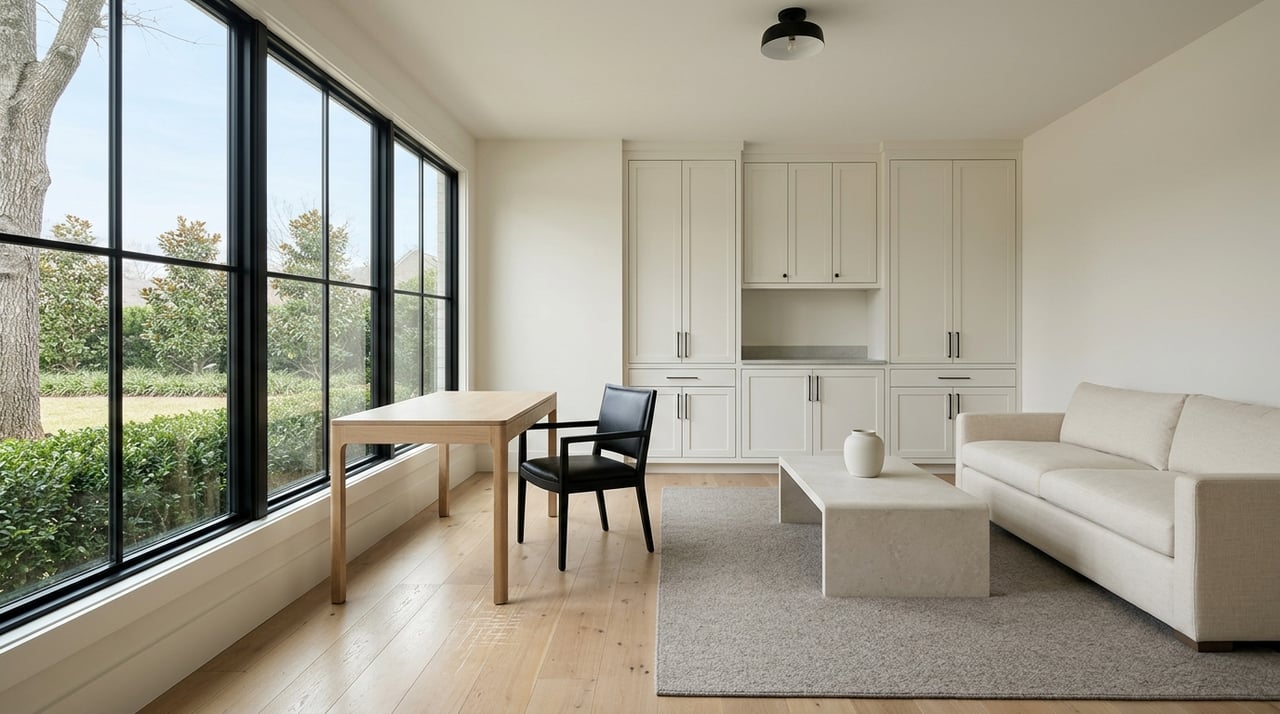
Remodeling often makes the most sense when your current home already sits on a lot that can support your goals. If the issue is layout, function, or finish level rather than the lot itself, a remodel may be the cleaner solution.
This is especially true when your needs can be met with work that stays within the property’s legal envelope. In Bellaire, that often means interior remodels, room additions, or accessory-structure work that fits existing zoning and site constraints.
A remodel may be worth exploring if:
If your project is limited to improving how the home lives day to day, you may be able to preserve the location you love without taking on a full move.
Sometimes the house is not the real issue. The lot is.
If your property cannot realistically support the size, layout, or site function you want, moving may be the more efficient path. Bellaire’s own planning framework supports this reality because the city is nearly built out, and owners often must choose between major investment in the current lot or finding a better-fit home in the same market.
Moving tends to make more sense when:
In a market where home values are around the $1.3 million range, it is important to compare the full cost of construction with the full cost of buying, not just the contractor quote.
This is one of the biggest decision points in Bellaire.
The city states that all development in the floodplain requires permits. It also says that under NFIP rules, any reconstruction, rehabilitation, addition, or other improvement that costs at least 50% of the structure’s market value over a 365-day period must meet new-construction standards, and Bellaire applies the higher Design Flood Elevation standard.
For homeowners, that can turn a straightforward addition into a much larger project. A remodel that looks manageable at first can become far more expensive if it crosses that substantial-improvement threshold or involves a flood-sensitive site.
If your home is in or near a floodplain, this is not a detail to check later. It should be one of your first questions.
Bellaire’s code environment is current, and that matters when you are evaluating timeline, complexity, and cost. The city says it adopted the 2024 ICC codes and 2023 NEC/NFPA 70 effective February 1, 2026.
The city also identifies SmartGov as the official portal for permit requests, inspections, and uploads. That means permit coordination is not just paperwork. It is a core part of whether your remodel is realistic and how smoothly it may move.
Bellaire also notes that a homeowner’s building permit may be used only if the home is a homestead and the work is a roof repair or remodel. The city further states that an amended plat is required when building on two adjacent lots or adding an accessory structure on the next-door lot.
If your project is getting more complex, licensed design, contractor, and permitting support becomes very important early on.
Zoning is only part of the picture. Bellaire says it does not enforce deed restrictions, so those must be checked separately with the Harris County Clerk.
That means a project that appears allowed under city rules could still face private restrictions that affect what you can build. Before you commit to plans, make sure you understand both layers.
A smart decision comes from comparing total cost to total outcome.
For remodeling, your budget should include more than construction. You should also consider design, permits, timeline risk, temporary living disruption, and any code or floodplain-related upgrades that may be triggered.
For moving, your budget should include purchase price, closing costs, moving expenses, and the ongoing carrying cost of the next home. Bellaire’s FY2026 adopted city property tax rate is $0.4174 per $100 valuation, and the city says it offers a 20% homestead exemption plus $135,000 exemptions for residents age 65+ and disabled homeowners.
Those ongoing costs are part of the decision. A home that solves your space problem may still need to work comfortably within your long-term monthly budget.
Before you decide, work through these questions:
If you cannot answer these clearly, you probably need more due diligence before making a big financial commitment.
The remodel-or-move decision is rarely just emotional or financial. In Bellaire, it is also highly physical and regulatory because lot size, setbacks, floodplain status, and redevelopment realities all shape what is possible.
If your current house can be improved within those limits, remodeling may help you stay where you are. If the site itself keeps fighting your goals, moving may be the cleaner and more value-conscious option.
A thoughtful local strategy can help you weigh both paths with clear eyes. If you want help thinking through whether to improve your current home or search for a better-fit property, reach out to Jaime Dossett for a free neighborhood consultation.
Stay up to date on the latest real estate trends.
I am committed to guiding you every step of the way—whether you're buying a home, selling a property, or securing a mortgage. Whatever your needs, I've got you covered.

Jaime Dossett Group
2800 Kirby Dr. Suite A-206 Houston, TX, 77098